Home Home About Me Products Freebies Contact Pinterest TPT Bloglovin Instagram Facebook
Showing posts with label math. Show all posts

Sunday, November 29, 2020

Christmas Visual Discrimination Freebie

I'm so excited to back.  It's been such a long time since I've written a post but I'm happy to be back blogging with my brand new redesigned blog.

In order to celebrate my grand re-do, I've made a new Christmas freebie.

Christmas visual discrimination freebie for pre-school

My students this year are very young.  Where I live, students can enter kindergarten at 3 years old.  Combine that with attention difficulties, vision issues and lack of exposure, we have a lot of work to do on visual discrimination.  Visual discrimination is really important for reading.  Being able to tell the difference between b and d,  e and c or t and l are essential for beginning readers.  

Christmas visual discrimination freebie for pre-school


We are starting with being able to tell the difference between pictures as well as working on the concepts of  "same" and "different".  Using simple Christmas pictures, we played a game of Concentration. 

We placed the pictures face down on the table, which when getting the children to help me, was a learning experience in itself.


Christmas visual discrimination freebie for pre-school
The children took turns turning over two cards and seeing if they matched.  We emphasized the words "same" and "different".  Are these two pictures the same? Yes? Then you get to keep the pair.  Are the two pictures different? Yes? Then you need to turn them back over and the next person gets a turn.


This game is also great for practicing turn taking and following the rules of a game.


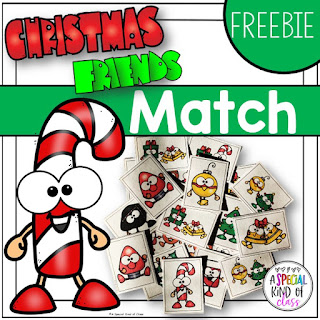
You can grab this free Christmas Matching Game by clicking on the picture below.


Christmas visual discrimination freebie for pre-school

Monday, February 6, 2017

Hungry Pigs Core Boards


When I got "Ten Hungry Pigs" in my Scholastic book order a couple of months ago, I instantly fell in love with it.  It's cute, funny and perfect for working on counting skills.  I knew this was the next book I wanted to adapt for my students.  


Core vocabulary is at the heart of all we do.  It's so much easier to work activities around core vocabulary (those set of words that we use most often) and add some fringe (those words specific to an activity) than to make theme or activity boards.  This way the children begin to learn where certain words are on their boards and learn to communicate faster.


When I do shared reading activities with the children, I read the same book everyday but vary the activities each day.

On the first day I have the children work on making the sentence "I see # pigs" by pointing to the words on their board.


We then make a large class book.  Each child makes one page and then we bind it together.  Some children are ready for the number word and some are working on the numerals.  The aim of this activity is to work on sentence structure.  Just because my students can't talk doesn't mean we can't be working on proper sentences.


On the second day we worked on making a big chart about what food each pig liked.  Again, we worked on making sentences and putting words together.


The children then made individual books to demonstrate their learning.  They completed the sentence and added the picture of the food item.  For children who are able to draw, I had them draw a picture of the food item.  For child who are non-verbal and have little fine motor skills, I held up two food item choices and had them eye gaze to the one they wanted.  I then used hand-over-hand to help them glue their choice into their book.


On day three we talked about personal preferences and what the children themselves liked or didn't like. These types of questions are great for getting to know the likes and dislikes of our class.  Don't worry about the vocabulary being exact on their communication boards.  "Not like" is perfectly acceptable.  Remember, we want them to use what they have to get their point across.  There isn't room on the boards for every negative.  Teaching the children to use the "not" symbol, opens up a wide range of options when it is combined with other words ( ie. "not happy" rather than "unhappy").


On the forth day we talked about what each pig put on the pile in order.  In this way we are retelling the story in order.  The children have practiced using a lot of the vocabulary already.


On the last day I concentrated on asking the children questions about the story.  It's important to practice answering questions that require more than a "yes/no" answer.  I tried to include some fringe vocabulary that would lend itself to questions.  The response sheet is made up of yes/no questions so that we practice both.

I hope you enjoy this book as much as I have.


Tuesday, December 27, 2016

Snowflake Calendar Numbers

Merry Christmas everyone.  
I hope you are having a wonderful holiday. 

I thought I would end the year with a little freebie for you to start the New Year.


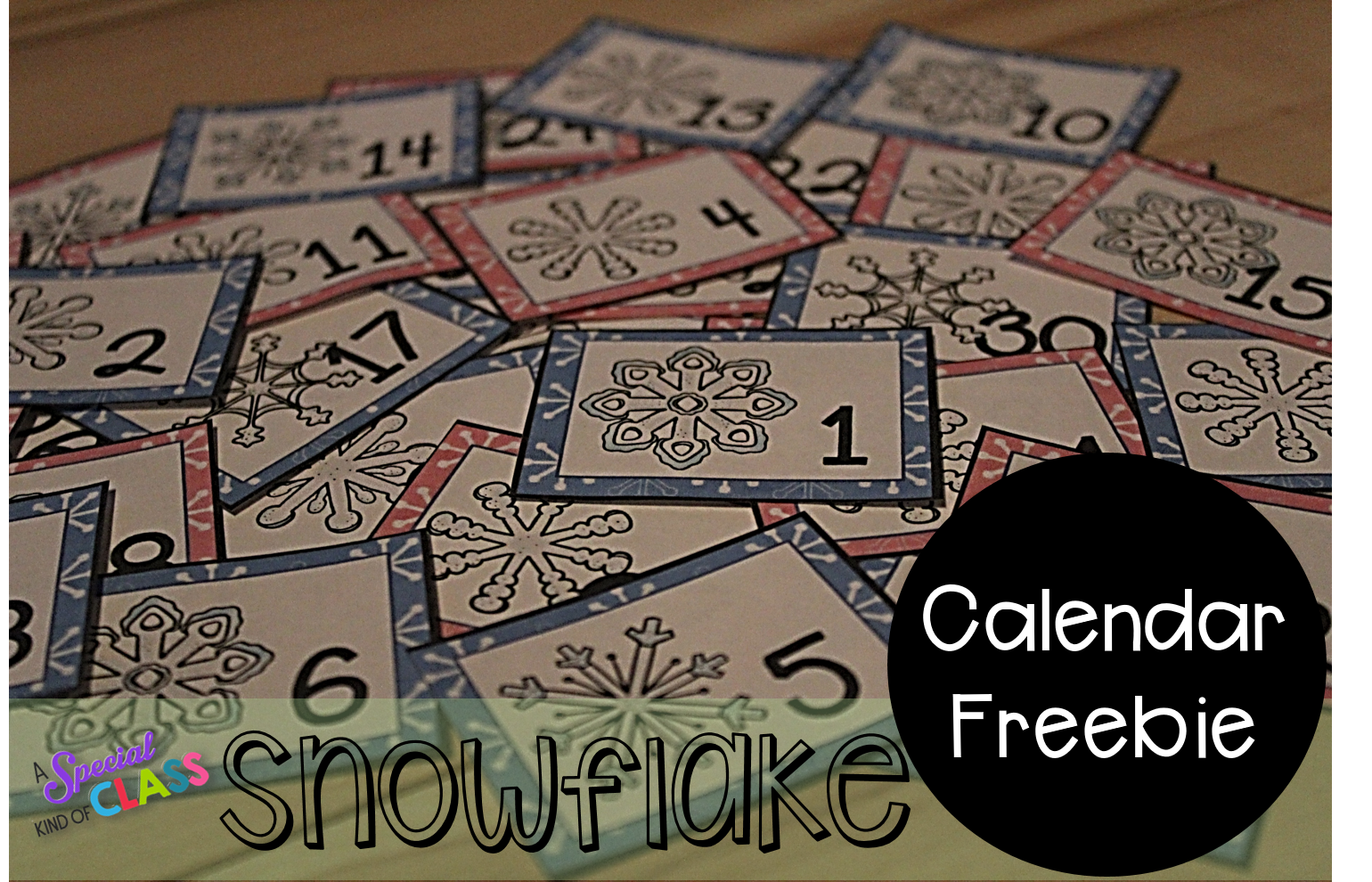
Besides using these numbers on your calendar, you can put them in your math work stations.  Have the children put the numbers in the right order.  There is also an AABB pattern.  Can the children predict the next colour?


If you make two copies of the numbers, you can play a matching game.  Use the numbers the children need to work on.


You can grab this freebie by clicking on the picture below.


Sunday, November 13, 2016

Math Manipulative Monday - Snap Cubes


Snap cubes are a staple in our class.  We use them for everything.  Great for fine motor skills, they can be used in both math and literacy activities.

The one thing that I really like about snap cubes for children with disabilities is that you can feel the circle on each one.  This is important for children with visual disabilities because they can clearly feel the difference between each one.

Close your eyes and touch each one.  Can you feel them?


When measuring, I use the snap cubes for children who need to "feel" the different cubes to help them count.  Putting their finger in each hole as they count, helps some children differentiate between them.


Sorting can easily be done with snap cubes.  The various colours make them easy to see and the chunky shape is easy to handle.


I like to use them for our hundreds chart.  We make rows of 10 and because there are 10 different colours they are perfect for counting by 10's to 100.  Because they snap together, they won't fall apart when you are working with them.


The snap cubes snap together in different directions.  This makes them perfect for joining together to make numbers and letters.  This is ideal for children who need to "feel" what they are doing and it's a very "hand-on" way to make number and letters.


I've used the cubes as counters during math work station activities.


They are great for working on one-to-one counting.  Once the children have placed one cube on each item, I have them move them off the card and count them.


 I like patterning with snap cubes because they stay together.  They are sometimes hard for little hands to push together but with some practice most of my kids have been able to do it.


In my math work stations I have patterning cards.  I sometimes have children that have a hard time picking them up, so I taped a snap cube on the back of each one.  I put one colour on the bears and one colour on the skunks.


Now they stand up nicely.


When you turn them around, there is still a pattern.  This is great for self checking their answers.


How do you use snap cubes?  
I hope I've given you a bit of inspiration to "think outside the box" and see what else you can do with them.


Here are the other posts in this series

Sunday, October 16, 2016

Free Pumpkin Counting Mat

Do you have children who need to work on their fine motor skills as well as counting and one-to-one correspondence?  Then this is the perfect activity for you.


Print out the colour version and laminate.  I printed out a few of them and ran a group activity.


I used play-dough and had the children roll ten small balls before we got started.  If you don't have play-dough, don't worry.  Use blocks, counters, or poker chips. 

I had each child roll a dice and then put that many balls on their pumpkin.  The first child to fill their pumpkin is the winner.


I also included a black and white version.  This one is great for putting letters, shapes or numbers on. Use a bingo dabber or crayons and dice that you can put what you want on them.

Click on the picture below to grab it for free.


Sunday, December 6, 2015

No Prep Polar Express Math

I love the Polar Express story.  Even before it was movie, I would read the book to my class.  For I few years we even put on the play for the parents.

For the past week we have been practicing some of our skills with a Polar Express theme.


We practiced counting and colouring.

Graphing was favorite.  For my students who colour in the boxes, we used bingo dabbers.  

I love these, because even if my students can't print well enough, I know if they can match and count.

This can be a little tricky but it's good practice to fill in the missing numbers. 


Patterns are part of the Kindergarten Ontario curriculum and the kids love this Polar Express pattern page.


 You can never have enough practice counting and matching numbers.


 I like to have the children practice putting numbers in order.


This one is a little tricky too.  There are several answers that go under each number.  I like to have the children practice cutting while they are working.  I love them working on more than one skill at a time.