Home Home About Me Products Freebies Contact Pinterest TPT Bloglovin Instagram Facebook
Showing posts with label The Next Step in Guided Reading. Show all posts

Friday, July 5, 2013

Chapter 3 - The Next Step in Guided Reading - Freebies


Welcome to chapter three of the Freebielicious Summer book study.  I'm hosting this week's chapter along with my good buddies Marsha, Jeannie and Lidia.


This chapter is huge.  There is so much information in it.  I decided to concentrate on the Pre-A group.  This will be the group that I will be teaching in the fall.  Some of the children in my group may not even have a yes/no response let alone know any letters of the alphabet.

I was really interested in information about tracing an alphabet book.  I have never done this before but I'm really interested by this concept and I'm excited to see if it works.  I made this booklet to give it a try.  You can click on the picture to grab the colour version for free.


The Pre-A Lesson Framework consists of Working with Letters and Names, Working with Sounds, Working with Books and Interactive Writing.

Each lesson starts by assessing the letter and sound knowledge of each student in the group.  I made up this chart but I might make up another one with all the children on one page.  If you want this one, you can grab it for free by clicking on the picture below.


Each child is suppose to have an alphabet chart so I made one of those too.  The pictures match the ones in the alphabet tracing book.  You can grab the black and white version below.


For "Working with Letters and Names", I'm going to make name templates for each of the children and get together personal letter bags for each of them.  I just ordered a bunch of new magnetic letters.  Again, names are not something I've spent a lot of time working on, so this will be new to me.  I think I'm going to be starting out with a pet theme.  We are going to be doing a lot of working with letters.  Picking out certain letters an sorting them.  This activity is from my pet literacy unit.


"Working with Sounds" will involve a lot of work on syllables and word families.  Finding lots of rhyming words too.  I'm going to have to make it very simple and use a lot of picture supports for this group.


 I have quite a few interactive books that will be perfect for "Working with Books".  I have four different types of books.  One is a regular book.


One has the sentence missing and the children need to put the right sentence on each page.
 

One has the animal missing and the children read the sentence and find the right animal.

 And the last one has a word missing and the children have to put the right word in the story.

Since it's more than likely that none of group will have any fine motor skills, the fact that  "Interactive Writing"  is using cut up sentences is going to work out perfectly.  I don't have any made up for pets yet but I think I will make some up like I did for my zoo unit.


I love the way that the book lays out a lesson plan for the whole group.  I know that when I go to do my planning in the fall, that I just have to pick the activities I'm going to do and slot them into the lesson plan.  I'm looking forward to being more organized.


If you want all my alphabet activities, including the colour and black and white versions of the book and chart, you can find them here, along with the matching alphabet posters.


Thursday, June 27, 2013

Chapter 2: The Next Step in Guided Reading - Freebies


This week's chapter is all about assessment  Here are the questions to think about.  

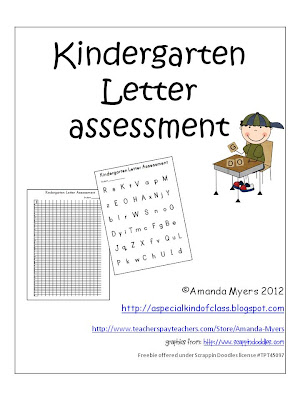
Below are the assessments that I use to test letter knowledge and sight words.  Each pack is free and they include instructions for testing children with little or no verbal skills.

At this stage I don't do dictated sentences.  Most of my children have little letter knowledge and poor fine motor skills so I don't think that this would be useful for me to do.  I don't really do a writing sample but rather a printing sample.  I have the children print their numbers and letters and their name each month so that I can see progress over time.  You can find the link below.  It is a paid product.

I do complete running records once the children have enough sight word knowledge.  I usually use the PM Benchmark kit.  This kit has a comprehension section so I usually use that.


I usually use my own assessments every day and I do a running record every couple of months or if I feel a child needs moving to the next level.  I don't usually introduce the text used in the assessment but I do try to make sure that the bulk of the words are part of their sight vocabulary.  I've never had the student read the text silently first, I usually do a picture walk.  If the student asks for help, I tell them.  I check to make sure that they remember what I told them the next time they see the word.  If I have to keep telling them, we need to work on it.  I usually ask a lot of questions when we read stories to check for comprehension.  When the books become too easy,  I usually do a running record to decide if a child needs to move up.

Thursday, June 20, 2013

Chapter 1: The Next Step in Guided Reading


I'm so excited for Chapter One of our new book study.  I hope that you will follow along with us each week and join in on the conversation.

For those of you who don't know, I teach at a very small school.  Next year there will be 32 students.  All have a speech and/or physical disability.  The children are split into 4 classrooms, 8 children in each class. 


Therapists come throughout the day and remove children for individual and/or group therapy.  At times, a class of 8 could become a class of 2 when children are gone for therapy.  Where am I going with this?  Well it's very hard to run math or literacy centres or have guided reading groups with only 2 students.

The other problem we have at the school is the varying ability levels of the children.  Each class might have several children that are working at or above grade level with children who are still working on making consistent yes/no answers.  When planning activities it is sometimes difficult to concentrate on certain skills with such a wide range.

Most of the children only stay with us for one year before being integrated back into their home schools.  We have only one year to make a huge difference in these children's lives.

When I read "The Next Step in Guided Reading" I got really excited.  I loved the whole the concept of the book but how could I run guided reading groups with such a small number of children?  How would I be able to run things with such a wide range in abilities and learning styles?

This year we came up with a radical plan that we are planning to implement in September.  During our literacy block, which is one hour long, we will combine all four classrooms and then redistribute the children into three larger groups based on ability.  This will allow us to concentrate on skills dedicated to each groups needs and will allow for some leeway if children leave for therapy.

This will be a brand new idea for us, so I know there will be lots of kinks to work out.  The children will be split into three groups.  Each group will have a teacher and one or more educational assistants with it.  We will need to focus on fostering independence in the children that are capable of doing independent work and provide support for the children who need it.  In the first 6 weeks we will be introducing read alouds, shared reading and independent reading to the children as a basis for what will come in the following weeks.  We will probably be doing these as whole group activities.  In this time, we want the children to bond with their classmates, learn to share, get along and build a rapport that will allow for productive work in the future.  We also need to get to know the students, their way of communicating, and the level of assistance that they are going to need within the group.  All of children (except one) will be junior kindergarten (3 to 4 years old) or senior kindergarten (4 to 5 years old) age.  Some will not have had any school experience before.  Because of their young age, I'm not sure that we will be using reading notebooks.

We only have one hour to get everything done so we are going to have to watch the clock.  I am going to get a timer and have everything well planned.  I think that the more well planned things are, the more likely that you are going to keep on track.  I don't have to worry about too much noise and interruptions from the children as each group will be in a different room.  The main problem is noise from the adults.  When children are picked up and dropped off for therapy, it's easy to get carried away getting updates at the time.  This can be loud and distracting for the group.  I think I might try and come up with a signal that everyone will know, that means "don't interrupt" and "quiet".  Updates can be done at times outside of groups.  It is also very easy for the adults in the room to talk to each other and for them to get distracted.  I'm going to lay out strict guidelines for what type of behaviour I expect from the adults in the room. I think clear expectations will lead to more productivity.  During our literacy block, we will have an extra teacher that will be able to do a running record on the children (or any other assessment deemed necessary).  This way we will be able to make sure that the children are picking appropriate books during self selected reading time.  All of our levelled books are organized into bins with the level number on the outside of the box.

This will be a huge undertaking next year and I'm so looking forward to the challenge.    I find when you do the same thing year after year, you lose your spark.  Doing something new with the children will renew some of the energy that can dwindle over the years.   I'm looking forward to sharing this journey with you.