Home Home About Me Products Freebies Contact Pinterest TPT Bloglovin Instagram Facebook
Showing posts with label interactive book. Show all posts

Saturday, April 1, 2017

Spring Adapted Readers

April is Autism acceptance month and I thought this was the perfect opportunity to show you how I use my adapted readers with ASD students.  My students often have several  characteristics that impact their learning such as little to no speech, poor or no fine motor skills and poor attention skills. 

  The first thing to remember is that all children, including those with autism, CAN learn to read.  The second thing to remember is that a child does not need to be able to speak in order to read.  
So how do we teach students with little to no verbal skills?  How do we prove it?

I had been adapting some of my commercially bought leveled readers by reproducing the text and then having the children move the words to make the sentence in the book.  The only problem was that because my students needed so many opportunities to practice the same words over and over again in different contexts, I ran out of books that were simple enough for them to read.

The other issue was that some of my students had poor fine motor skills and pieces would often slide off slant boards or get knocked to the ground by shaky fingers.  I needed Velcro.

I decided then that I would have to make my own. 


Since spring was coming up, this first set is geared toward spring activities.  Book one has three words per page and book two has four.

By limiting the options that I give to the children, I gear it to their level.  Once the child gets good at finding words, I will add some distractors to make sure they are reading the words in the book.


I also made some take home books that the kids could cut and paste, color and then share with their family.


Flash cards with some of the vocabulary in the books were used for "write the room" and comprehension activities.


The problem with standardized assessment kits is that the comprehension question require verbal skills.  How do we prove a child with no verbal skills can read?

Can they pick out sight words?
Can they match sentences to a given picture? 
Can they answer comprehension questions?

I made some comprehension questions to go with my stories.  There is one question per page.  Some of the questions require general knowledge and some require relating the story to their life.  All the questions can be answered without verbal skills.


I've included an assessment sheet to keep track of your students answers.
Comprehension question choices can be reduced to three or even two choices if students need more limited options.


Sunday, February 12, 2017

More Pigs

Pigs, pigs and more pigs.  

My kids are totally into pigs right now, so I decided to make up some more pig books.  

I love making interactive books.  Designed especially for my SPED students, I find that interactive books improve expressive and receptive language skills while allowing my students with poor fine motor and attention skills to participate.  Interactive books also allow children with no verbal skills to participate in the reading process by using eye gaze.

I made three different books so my students could work on number skills at the same time.
The first one has a blank spot in the sentence that the kids have to put the right number in.


Count the pigs and add the number.


Switch the numbers for number words if your students are working on words.


The second and third books are the same (one has the number word and the other the numeral).  In these books, the children have to add the right number of pigs to match the sentence.  There's a surprise at the end of the book.


My students always like to make their own books too, so I also made black and white take home versions.


I also made some flash cards.  I find them handy for students to refer to.


Friday, June 10, 2016

Adapted Calendar for SPED kids


http://bit.ly/yearlongcalendar1


For me, school isn't finished yet but I'm already thinking about next year.  
Calendar is one of my favorite parts of the day and these take a bit to get set up so I want to start now.

When I first started to do a calendar program with my students, I struggled with how to include everyone.  I had a diverse group of kids.  I had several students on the autism spectrum, several with physical disabilities and several with speech and language issues.

I had several students with no verbal skills at all but their fine motor skills were fine.
And I had children with verbal skills but poor fine motor skills.
And then I had some children that didn't have any verbal or fine motor skills.

How was I going to include everyone?

What I came up with was a interactive calendar that everyone could participate in.


We start our calendar by talking about what day it is.  At the beginning of the year I only have "Today is" showing but when they get good at that, I replace the page with this one that includes yesterday and tomorrow.


In order to keep my "printers" busy while other students are still picking the day and making their sentence, I have them fill out this sheet that has them print out the date.


I also have them trace the number on the calendar.


We count the number of days that we have been at school.  In order to give students that can't colour an opportunity to participate, I made this 100 chart with Velcro.  The squares are removable so that the children can see the number of days.


For my students that can colour, I use this sheet.


I have a couple of options for the weather depending on the skill level of each child.


I then have each child read their sentence back to me. Using a pretend microphone is a good motivator.


We also make a graph of the weather for the month.  This one is for my students that can't colour.


And this is one for my students who can colour.


After we talk about the weather we dress our friend for the day.  I have boy and girl friends and they love dressing them.


We do patterns next.  We start off doing simple patterns and progress to more difficult ones as the year goes by.


This year we started doing 10 frames.  I would hold up a number or a set of dots or say a number out loud and the children would have to fill in their 10 frame with the correct number of dots.


As the year progresses I add more and more pages to the book.  I start out with a basic book and as the children become more proficient in their skills, I add harder skills.

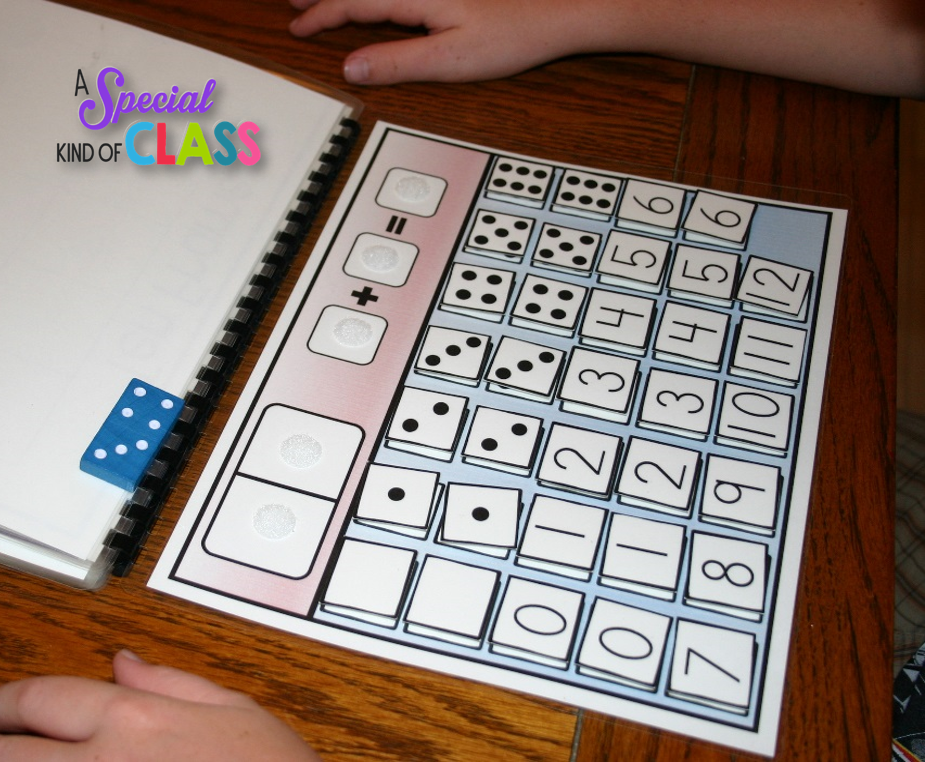
One of the higher level skills I add is adding.  Each day we pick a domino.  I have the children make the domino at the top of their sheet.


They then translate that to numbers and then show the total.


For my students that need more fine motor practice I also have some extra sheets for the to work on.

Tracing at the beginning of the year.


The alphabet as the year progresses.


After the 100th day of school I switch from counting to 100 to doing tally's.   


 I do time with my grade one's.


This one I've done several ways.  At the beginning of the year I call out a number and have the children colour in the matching circle.  I use bingo daubers with children with poor fine motor skills.  Later on in the year I hold up circles with dots in them, have the children count the dots and then colour in the circles.  I also have a sheet with teen numbers.


The last one I do is shapes.  I call out a shape and have the children colour in the matching one on their sheet.


http://bit.ly/yearlongcalendar2


Monday, March 14, 2016

Interactive Books - The Farm

I'm so excited.  
It's been so long since I've made something new that I forgot how excited I get to show the kids something new.

I decided to make a couple of farm interactive books.  Interactive books were the first things I ever made and I just love making new ones.

I decided to make these ones a little smaller inside.
I kept the outside cover the same size so that when you store them, you don't catch the pieces and they won't fall off.


The two books both have interactive pieces.
The first one has words and the children need to put the correct word in each sentence.


The second book requires the children to read the sentence and put the right animal in the picture.


I also made some flash card that I could put up around the room for the children to refer too.


I also made the same books in a black and white version so the children could cut and paste and then take them home.