Home Home About Me Products Freebies Contact Pinterest TPT Bloglovin Instagram Facebook
Showing posts with label literacy. Show all posts

Wednesday, August 9, 2017

3 ways to increase vocabulary using word wall cards


Many special education students don't have the experiences that their typically developing peers have.  If a child cannot walk or talk, cannot hold things or turn their head in certain directions, then their view of the world is different from other children.  Autistic children often experience the world in ways that differ from those of other children due to the nature of their condition.

Because of this, it is very important for us as teachers to make sure that our students have experiences to expose them to situations, events and vocabulary that they may otherwise not experience.

Word walls cards also known as flash cards are a great tool to use for testing and practicing new vocabulary.  How to you use them in your class?  Here are 3 ways that I use word cards in my class to test prior knowledge and increase the vocabulary skills of my students.


When introducing a new topic to my students, word wall cards are a great way to see what they know.  When we started our farm theme I asked my students if  they had been to a farm before.  Did they know what a farm was?   What kind of things would we see on a farm.  We made several CHARTS which demonstrated what they knew about farms.  Testing prior knowledge is very important to know where you are starting from.  We started out by just putting up words they knew such as the animals on the farm.  As the month progressed we added vocabulary that did not belong on a farm and I had the children tell me what did belong on farm and what might not be on a farm.  You can make charts of farm animals and farm people and farm equipment.  The possibilities are endless.  Display the charts around the room for your students to refer to throughout the day.

Do you have a child that can't talk?  No problem.  Hold up two pictures, one that belongs on a farm and one that doesn't.  If they can point, have them point to the correct answer.  If they can't point, have them look at the right answer. 


Once I've determined what vocabulary my students know and what they have to work on, I add the word cards to my WRITING center.  Students can practice writing just the words, they can use the cards to help with spelling in their stories or they can use them as story starters.

Did you have a child that can't print?  Put the cards at the computer station for them to type.  Even children using assistive technology can practice typing.


The third activity I do with my word cards is to put them in a literacy center as a CONCENTRATION game.  I make two copies of the cards and put out a varying number depending on the group and how well them know the pictures.   The kids love this game.  It's also great for working on turn taking.

For children with poor fine motor skills, laminate and put Velcro on the cards.  Attach them to a Velcro board so they don't get knocked to the ground.  


How do you use word wall cards in your class?


Saturday, August 1, 2015

Interactive Books - The Enormous Turnip

I'm so excited that I finally finished my newest interactive book.

"The Enormous Turnip" was a favourite of my students this past year.
We even did it as a play for the parents at the end of the year.

When I saw this beautiful clip art, I just knew I had to make it into an interactive book.


There are 6 books in total.  Two of the books just have the story, one more detailed than the other.  I read the detailed one to the children a few times.  The top edge of the book is cut out to reveal a new character each time you turn the page.  When the children know the story, I switch to the simple book, which is easy enough for the children to read themselves.


The next two books have movable words.  The first book allows the children to put the name of the character on the correct page.  The other book has the children working on the word "pulled".


This is my favourite book.  As the story is read, the children find the correct character and put them on the story board.


The last book has the children adding the whole sentence to the correct page of the story.

All 6 books, along with flash cards are on sale for 1/2 price until tomorrow.


Wednesday, July 15, 2015

Work Station Wednesday - Summer activities


This week's work station activities were from my summer pack.  I didn't get a chance to take any pictures this week so I thought I would at least show the previews.


We were working on putting the alphabet in order and kids loved using the Popsicles.


We were also putting numbers in order.  

It was a little more difficult to filling in the missing letter but the kids enjoyed using the dry erase marker on the flip flops.


The dry erase marker came out again to fill in the missing number on the ice cream.

"More than", "less than" and "equal to"  are concepts we are just starting to work on, so these were perfect to work on these skills.


The last activity we did was beginning sounds. The kids are getting good at this activity now.


Wednesday, July 8, 2015

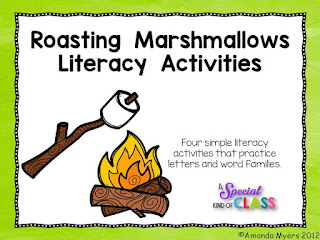
Work Station Wednesday - Marshmallows


This week's work stations are about marshmallows.  
Marshmallows are perfect for a camping or summer theme.

We combined marshmallows with our literacy work.
I also used the snap cubes that I talked about on Monday.

Our first activity involved putting the alphabet in the correct order.
I had some skewers in the cupboard and thought they would make perfect marshmallow sticks.
I attached a letter "marshmallow" to each snap cube and had the children thread them on the sticks.
Perfect fine motor work and they were easy to pick up.


Next we did some work on "missing letters".  The children had to find the marshmallow with the correct letter and place it on the card.  For some children I had cards with Velcro.


For other children I put the "marshmallows" on snap cubes so they were easier to manipulate.


 Next, we matched upper and lower case letters.


We then worked on word families.  Again I put the "marshmallows" on snap cubes and had the children put them on the sticks.


Once the children were finished, I had them read the words to me.


I put the word families on separate coloured snap cubes.  That way I could easily visually check to see if the children completed the task correctly.


The last game we played is a favorite.  Under one of the marshmallows is a picture of a piece of chocolate.  The children had to read the word first in order to look under the card.  The child who finds the chocolate is the winner.


I attached snap cubes to the corners of the cards so that the children could easily pick them up.