
Home Home About Me Products Freebies Contact Pinterest TPT Bloglovin Instagram Facebook

Wednesday, July 1, 2015

Work Station Wednesday - Forest Animals

It's work station Wednesday and I'm going to featuring some work station activities each week.
This week, I'm featuring forest animals.


This activity works on missing numbers.  I put Velcro on the blank spot so that the owls won't move when the children place them on the cards.  This reduces frustration when the children are working.  Children with poor fine motor control often have difficulty keeping pieces in place and can easily knock the pieces off of the cards.  


Patterning is the next activity we did.  The colourful cards made it easier for children with visual difficulties to see.
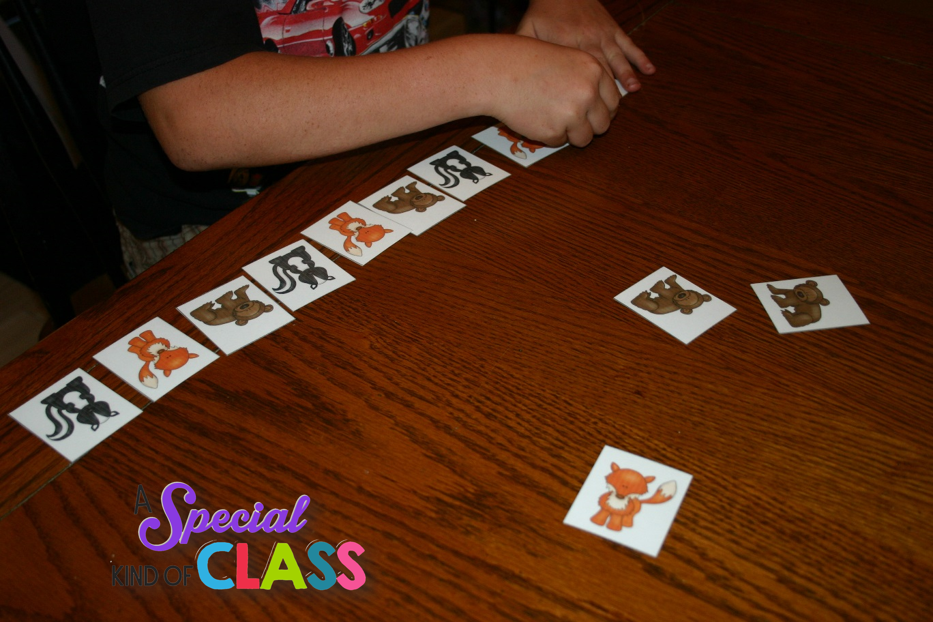


Next we did a memory game.  I had the children find the number card and match it with the correct number of animals.


When working on adding, I had the children roll a dice.  I find dice easier to use than spinners.  Spinners require fine motor control that a lot of my students don't have.  Dice can be placed in little hands and all they have to do is drop it.
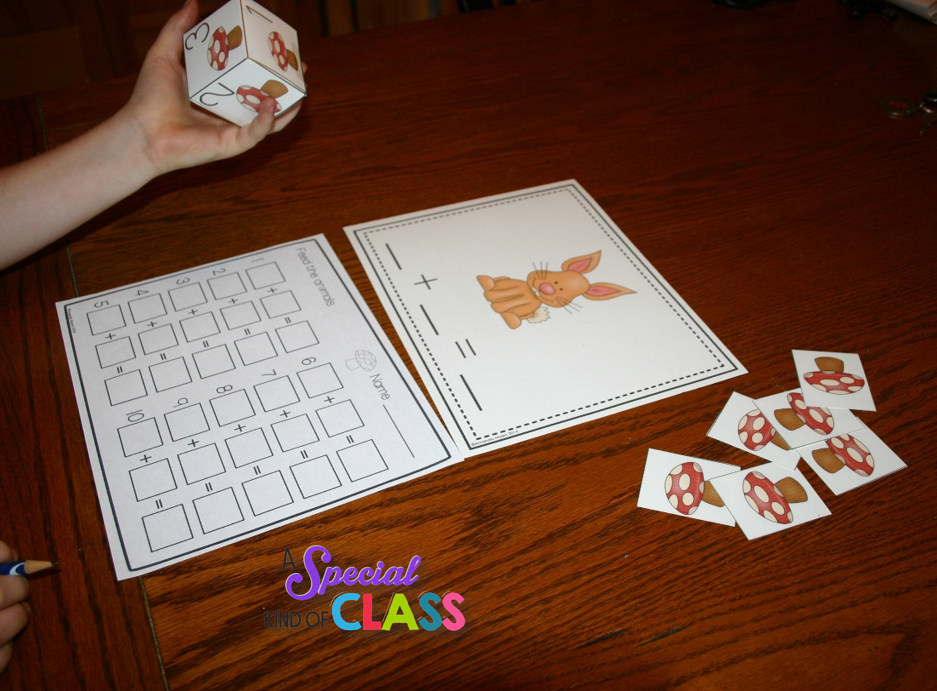

Having the children place the correct number of mushrooms on either side of the rabbit, helps them visualize the concept.


I do use a response sheet for children that can print.  If children can't print, I often use number stickers or stamps.


Matching ten frames are next.  Ten frames are a great way to visualize numbers to ten.


Ordering numbers is another skill that we work on a lot.  I mix them up and have the children put them in the right order.


Our last activity is measuring.  I used mushroom strips and the children had to measure the trees and find out how tall they were.


Tuesday, June 30, 2015

Testing Tuesday - Letters

One of the many things I get asked, is how to test challenging students.
How to do test children who can't give you a verbal answer?
Today's Testing Tuesday is centering around testing the letters of the alphabet.


I printed out 2 copies of the alphabet (the freebie is at the end of the post), cut out one, and Velcroed it on top of the other one.  I can keep this in a binder and when I need it, it's ready for me to grab.


If a child is non-verbal and has very little fine motor control (they can't point to a choice), we often use eye gaze to determine answers.  Since I often work with beginning users, we start with a choice of 2.  The easiest way to do this is to pick two letters and hold one in each hand beside your head.  This way, you can easily see where they are looking.   I will ask the child "I want to look at the "f ".  Where is the "f"? "


I want to make sure that they have looked at each letter.  So I move each one forward saying "Is it this one?" (ensuring eye contact).


"Or this one?" (ensuring eye contact). "Which one is the "f"?"  Depending on the ability of your student to hold their eye gaze,  you may require them to hold their gaze on a choice for a few seconds or you may take the first one they look at.  Avoid repeatedly asking "Was it this one? Or this one?" Just take their first answer.  Otherwise we are telling them:

1. I didn't understand you.
2. I don't believe your first answer.
3. I'm not listening.


If I have students that are able to point to, or pull off answers but are still non-verbal, I use a board like this.  It's just a piece of fiber board with a strip of Velcro through the center.  It's perfect for holding up in front of children in wheelchairs so they can reach the answers.  Some children prefer to reach for answers even through they can still look at their answers.


Decide how many choices you want to give the child between 2 and 4 and space them out.


Ask the child to point to a certain letter or to pull it off and give it to you.


I've included a recording sheet in the freebie so you can keep track of what the child does.  Are they mixing up letters like "b" "p" and "d"?  Are they able to get the letters in their name?


For my students with speech disabilities that can handle more letters per pages, I use this sheet.  Starting at the top, I point to each letter and ask them to tell me what it is.  If they know it, they can highlight it with a highlighter.  If they miss more than 3 or 4, I ask them to point and tell me any letter on the page.  Again, they highlight the ones they know.  I ask them the letters everyday and they highlight them as they get them.


I keep track on my tracking sheet which ones they know.  It's easy to see at a glace what we need to work on.  It's also easy to grab if admin want data, as it's all on one page, and it's easy to see their progress.


You can grab my Letter Assessment for free by clicking on the picture below.


Monday, June 29, 2015

Math Manipulative Monday - Colour Tiles

For the next month I'm going to be trying something different.  
Each day I will focus on something different.

Monday's will be about Math Manipulatives.
Each week I will highlight some different manipulatives and offer suggestions on how to use them with children with disabilities.


Here are the other posts in this series


This week I'll offer a few suggestions for colour tiles.


A few years ago I was doing some measuring with non-standard measurement tools.  We were using the colour tiles to measure some forest animal pictures and they kept sliding off before we could line them all up and count them.

Our solution - put Velcro on the back.


We put Velcro on the back of the tiles and a strip of Velcro along the arrow.
The Velcro is a little hard to see in the picture.


The tiles now easily stick to the Velcro and stay in place while the children put them along the arrow and count them.


For my non-speaking children I offered them numbers to pick from to determine if they could tell me how many blocks they used.


The other activity we did with the colour tiles was for my older students.  Our grade one expectations require the children to use a 100 chart and explore counting by 2's, 5's and 10's.  Once again, this is a nightmare for children with poor fine motor skills and coordination issues.  Spastic movements will cause all the tiles to go flying and lead to frustration when they have to start over.

Once again Velcro came to the rescue.  I lined the top the numbers with Velcro and the children could place the tiles on the number of their choice.


Even holding the board upright in front of a child didn't displace any of the tiles.  This was perfect for children in wheelchairs and standers or for those children with visual impairments who needed the board closer to their face.


Thanks for stopping by and I hope you will come back next week for more math manipulative ideas.